
When naked was negotiable
A history of nakedness, messy rules, and who gets to decide

There is a lot of nakedness on this blog. I don’t do it on purpose. But I won’t edit it out either. Walk through a museum of classical art and it’s wall to wall skin. Bodies. Bodies. Bodies. Yet no one says a word.
Contrast that with Reels and TikTok. There you’ll see that same nakedness in old art blurred out by some panicked creator who’s terrified of crossing the algorithm. We’ve reached a point where they blur a Rubens with the same frantic energy they use to hide a dog’s balls drifting into a wide shot. All for the sake of demonetisation. Let that sink in.
There are few things that tick me off faster. Back in 2018 I picked a fight with Facebook over Rubens after they banned a campaign I was involved in that was meant to promote the old master. That fight turned out to be better promotion than we ever could have hoped for. Facebook folded and Rubens’s voluptuous nakedness was suddenly allowed. Nearly a decade later, the algorithms have quietly pushed us back into the same digital fig leaf.
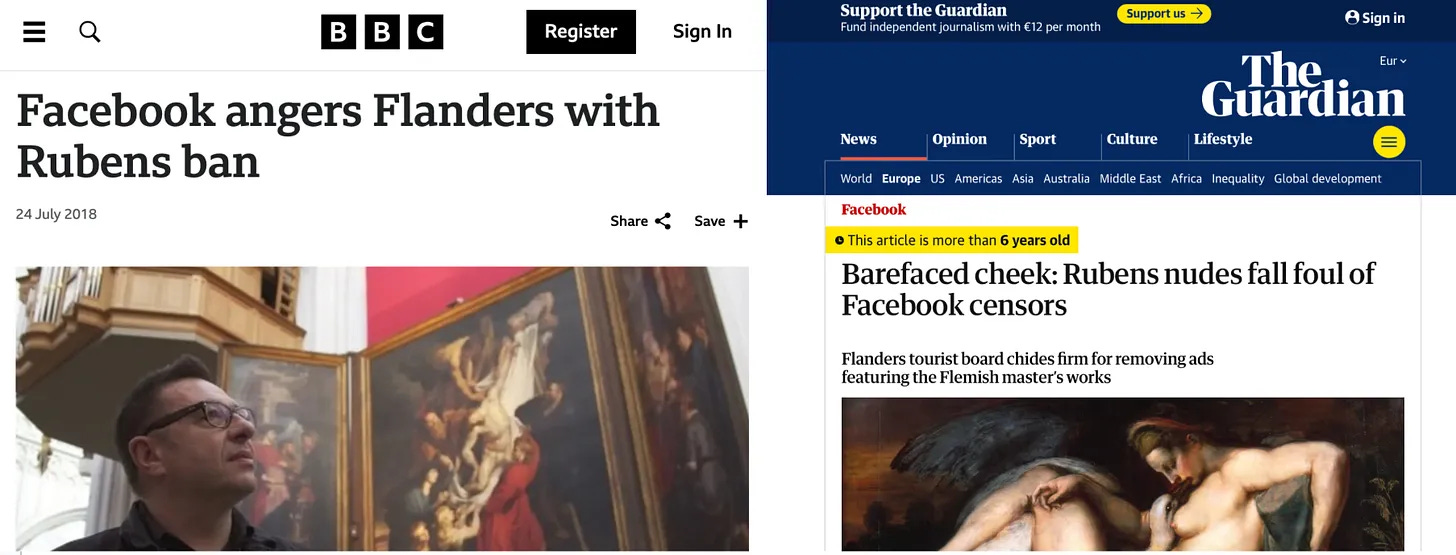
This isn’t just about a few pixels. It’s about a broader and more dangerous cultural trend I’ve been tracking for years. On this blog I’ve written before about my anger at big tech sanitising our history and our humanity. You see it in Hey AI, Why Can’t We Delete the Wife?, where we’re essentially teaching machines to be more ashamed of the human form than we are. Although OpenAI seems to be flinching, as I expected in Porn Might Be Doing It Again. It’s oddly comforting to think that human desire will always find a way.
But this post isn’t really about that.
This essay is about how society throughout history have always found loopholes around taboo. Art history is the longest running user manual we have for dealing with power, fear, and forbidden things.
Art history is the longest running user manual we have for dealing with power, fear, and forbidden things.
It’s about taking the body out of its prison of pornography where it was neatly locked away. It’s about seeing skin for what it is. This is about when judgment was human.
Showing your penis came with a gym subscription
In Ancient Greece, artists didn’t need a loophole for male nudity. At least not as long as the body was considered perfect. The Greek mindset was obsessed with the idea that a beautiful, athletic body equalled a virtuous and heroic soul. Nudity wasn’t a state of undress, but state of being. To be naked was to be heroic. At first, that rule applied only to men.
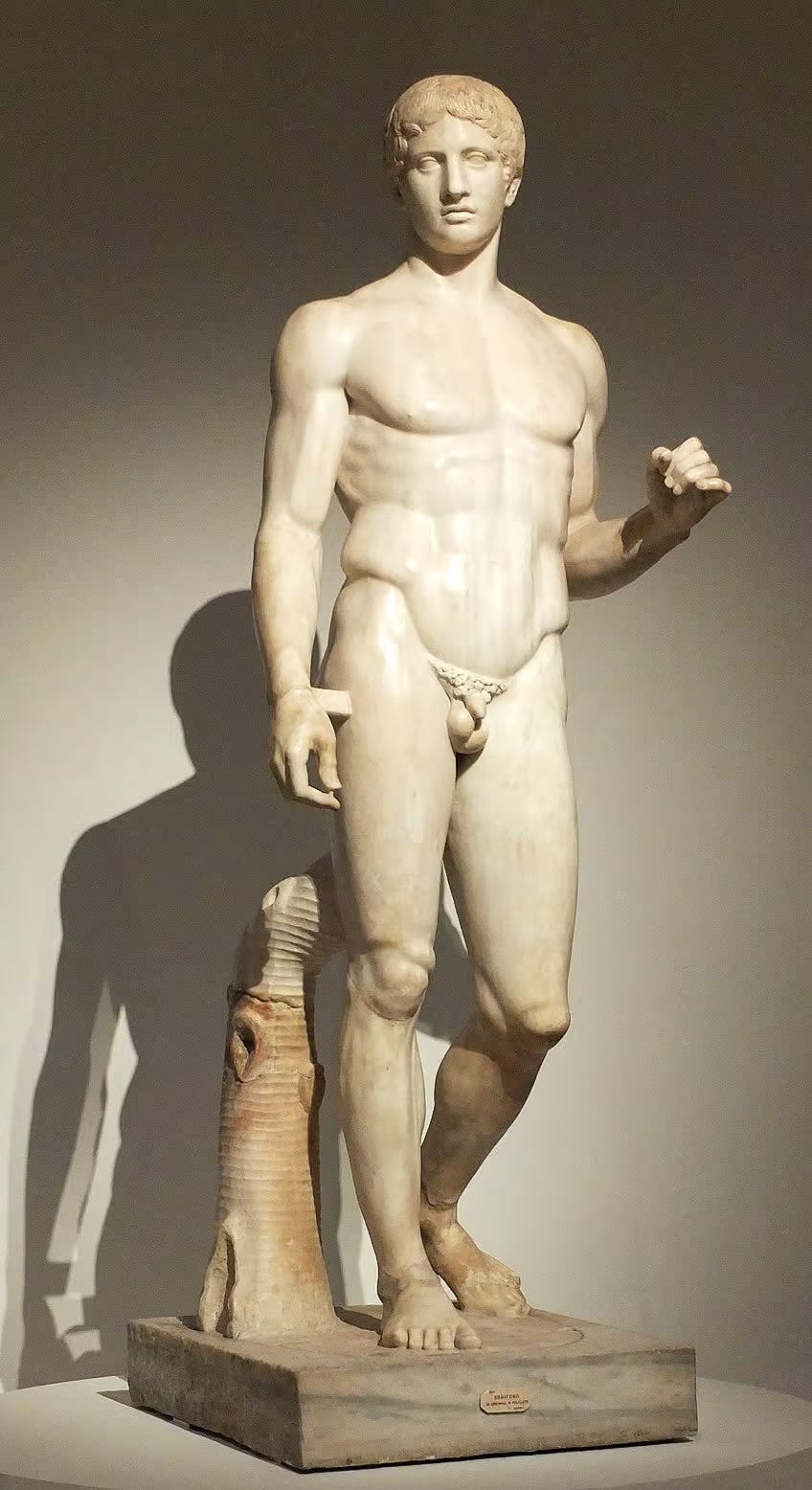
The real story starts with statues like the Doryphoros. By sculpting a perfect hunk, Polykleitos set the standard for proportional perfection. He called it the Kanon. In Greek gymnasiums, (from gymnos, meaning naked) men competed, trained, and debated philosophy completely unclothed. This wasn’t scandalous. It was civic pride. A public display of health.
But as beautiful as that might seem, the double standard creeps in and ruins the picture. Female nudity was frowned upon and treated as a threat to piety. There’s the famous story of the courtesan Phryne, put on trial for claiming she modelled as Aphrodite. When the defence was failing, her lawyer allegedly stripped her naked before the judges, arguing that beauty this divine could not be unholy. She was cleared, free to go home. Case closed.
Her lawyer allegedly stripped her naked before the judges, arguing that beauty this divine could not be unholy.
It wasn’t until the Aphrodite of Knidos around 350 BC that a life sized female nude was tolerated, precisely because she was a goddess. Praxiteles gave the world its first respectable excuse to stare at a woman’s body. Because it was Aphrodite, theology, not porn.
Nakedness was in those days the high performance gear. A signal of perfection reserved for athletes and gods. We like to think we’ve moved on, but we’re still worshipping the same cold ideal, just in higher resolution on a Calvin Klein billboard. Exposure is allowed as long as it promises power or peak performance. If you’re an athlete (or look like it), you can be naked. If you’re average, you’re inappropriate.
Biblical plotholes were worse than nudes
After centuries of celebrating the body, the Middle Ages arrived and killed the vibe. Your body became a vessel of sin. Life on earth was temporary and the flesh was a constant threat to the soul. Saints were wrapped head to toe in fabric. That was the rule.
But, there was a way to see butt. Some Bible stories are impossible to illustrate without nudity. Adam and Eve, for instance. Dressing them would create a plothole, because shame only appears after the apple of wisdom.
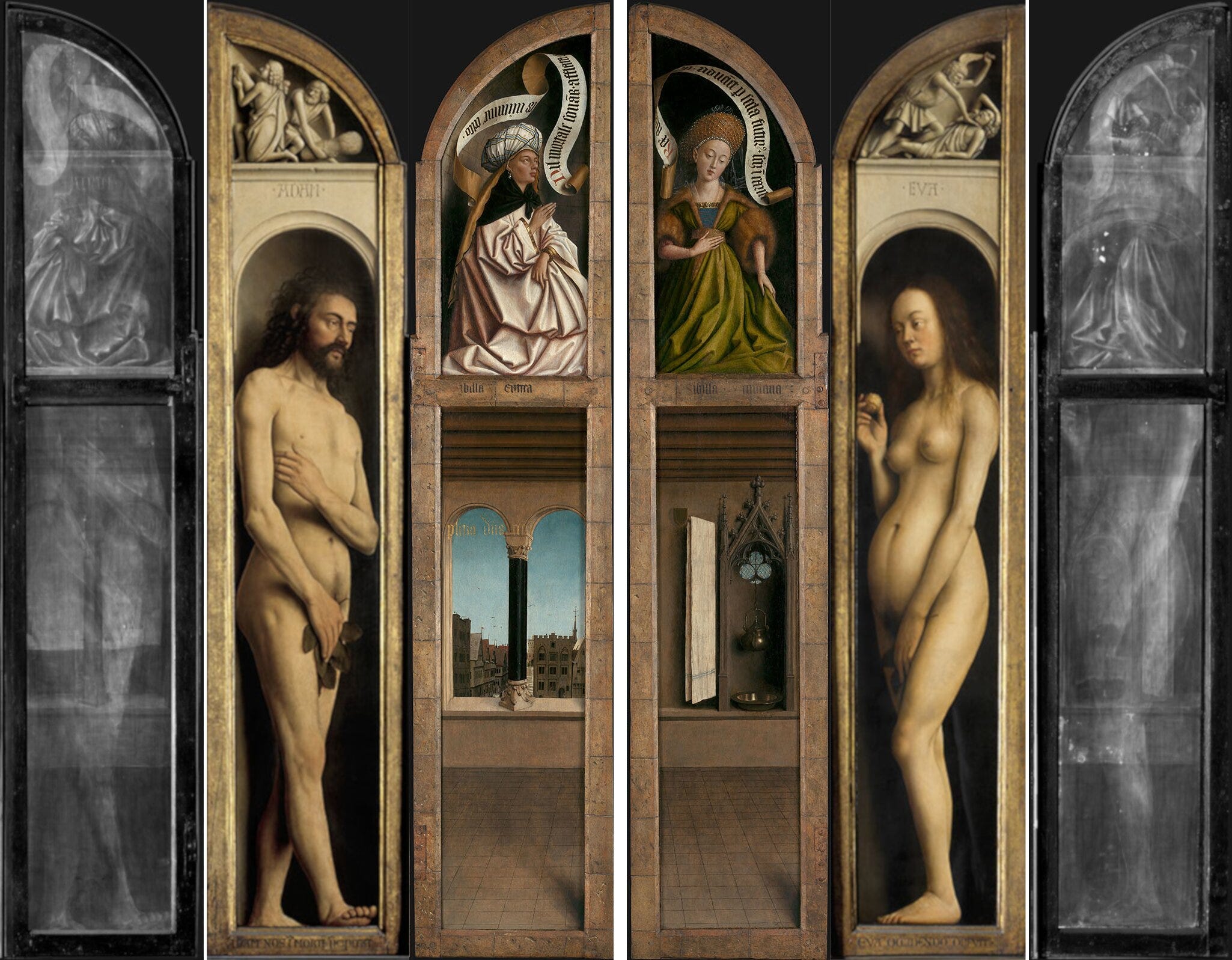
The compromise was an aesthetic of anti beauty. Look at the Adam and Eve panels in the Ghent Altarpiece. Technically painted in early Renaissance but the point still holds. Van Eyck’s hyper realism isn’t there to seduce. Adam is awkward and scrawny. Eve’s body bulges. This isn’t bad drawing or me doing some body-shaming. Again, it’s theology. Naked without the risk of lust.
By showing bodies that looked ordinary and unidealised, Van Eyck’s innovative realism turned nudity into a reminder of the vulnerability and shame of the Fall. It was meant to trigger pity for the corruptible state of your own flesh.
This is the ancestor of today’s educational exception. The body is allowed in public only when it’s doing moral labour. As in a campaign for breast cancer awareness, skin campaigns. Real bodies with a lesson attached.
The Saint Sebastian trap and the fig leaf panic
The High Renaissance brought the heroic body roaring back. Think of Michelangelo’s David or Cellini’s Perseus or Giambologna’s Rape of the Sabine Women. Just take a stroll through Firenze, you can’t swing a dead cat without hitting marble perfection.
The Renaissance was the birth of Humanism. The thinkers of the time decided that man was the measure of all things, and the best way to honor the Creator was to perfect the anatomy of the creation. The Church quickly realised anti beauty wouldn’t fill pews anymore, so it needed a excuse to go off brand. Enter Saint Sebastian.
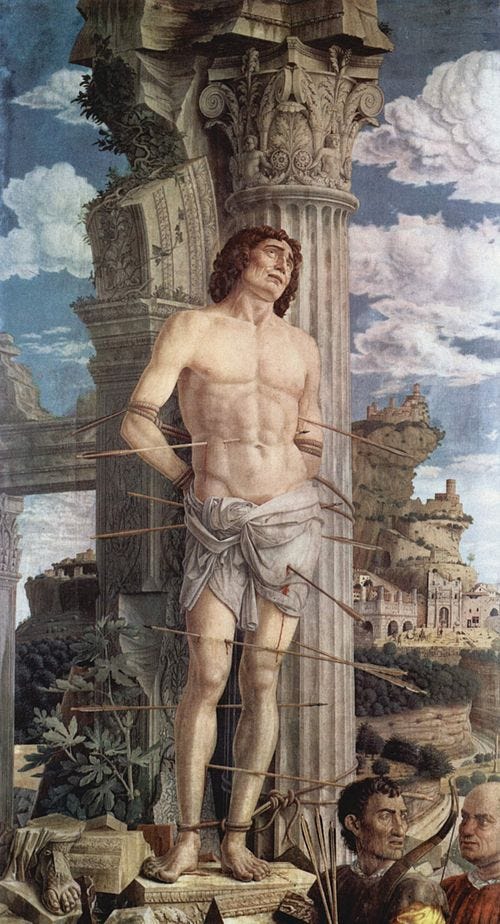
Mantegna’s Sebastian looks like he belongs in a fitness magazine. Lean, elegant, and carefully posed. The arrows feel almost like an afterthought. Suffering became the alibi. As long as you were being tortured for God, you could be as beautiful and naked as you liked.
Fra Bartolomeo’s Saint Sebastian was reportedly removed because women admitted it inspired lustful thoughts
The excuse worked too well. Fra Bartolomeo’s Saint Sebastian was reportedly removed because women admitted it inspired lustful thoughts. The martyr was too hot. Centuries later, Belgium had a similar scandal when a statue of Lucifer proved dangerously attractive. Same problem. Different branding. It’s a story I dove into in Sympathy for the devil, with a sexy Belgian devil.
The backlash was inevitable. The Counter Reformation ushered in full content moderation. Michelangelo’s Last Judgment was censored. Daniele da Volterra was hired to paint underwear on saints, earning the nickname Il Braghettone ”the breeches-maker”. Even classical statues were fitted with marble fig leaves.
The sacred loophole had snapped. This is how the nude was censored once again. They had followed the hype, but drifted so far off brand that only a moral wrapper could still make exposure acceptable. Strip that away, and the frowns quickly follow.
When virtue became voyeurism
The 16th and 17th century took the biblical loophole and added a darker, voyeuristic twist. And once again, we run into a double standard. In art history, but less surprisingly, in the Bible itself. Scripture has very little room for female characters, and when they do appear, their role is often tied to deceit. Delilah brought down Samson. Jael invited a warlord in for milk and nailed his head to the floor. Judith seduced Holofernes before cutting off his head. Michal, Esther, Tamar, even Eve. The Bible more or less invented the femme fatale.
The seductive temptress who leads men into sin is a powerful trope, but it comes with a practical requirement. Anti beauty is not an option when seduction is part of the brief. You can’t lead a man to his doom if you look scrawny or ashamed. Male painters understood that and took that liberty a bit too far.
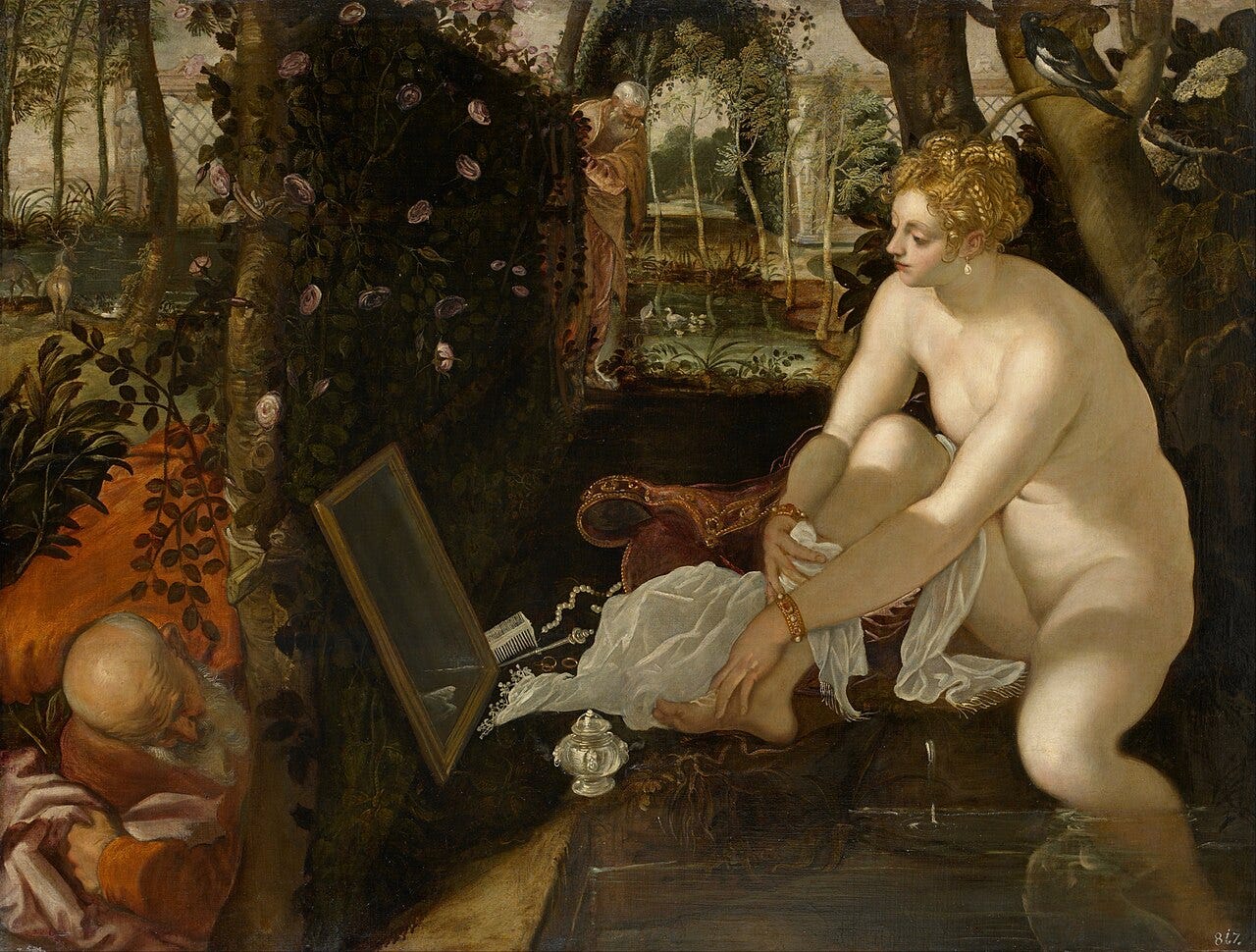
Take the story of Susanna, where two old judges spy on a woman bathing. It was a perfect brand safety scam. You get to paint a naked woman at her bath and claim it’s a moral warning about the dangers of lust. Most male masters, like Rubens or Tintoretto, painted Susanna looking coy, almost inviting the attention, as if saying she was asking for it. They were catering neatly to the male gaze of their patrons.
Artemisia Gentileschi, bless her, refused that framing. Her Susanna is a young girl in visible distress. There is no posing here. She twists her body away from the leering men who press in on her like a physical weight. Artemisia, having endured sexual violence herself, knew that being watched without consent is a violation.
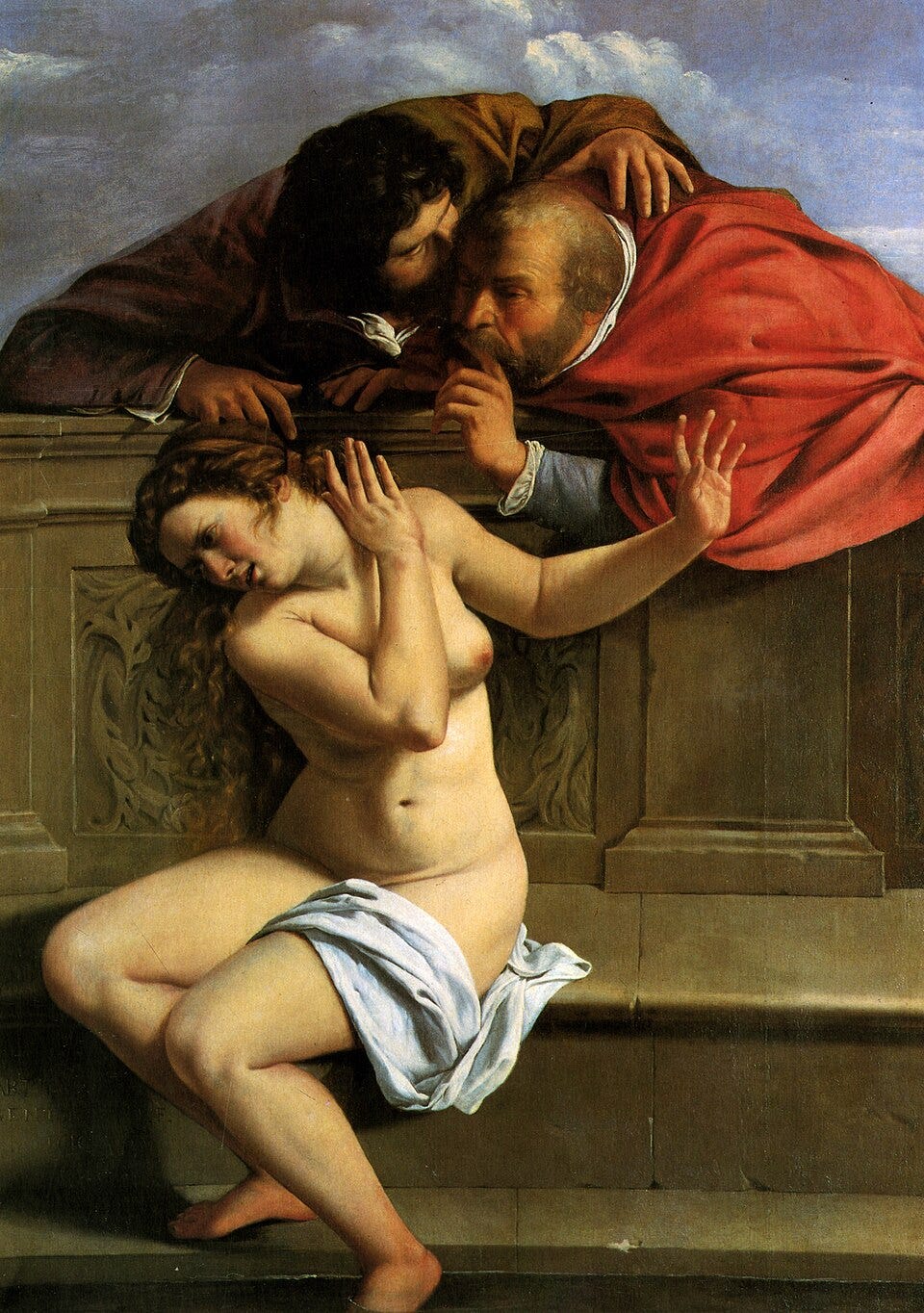
By today’s standards, this loophole wouldn’t pass a basic check. It reads like tabloid morality, a thin veil used to justify objectification. Artemisia reminds us that authenticity isn’t about decoration, but about who owns the gaze. Representation without agency is just another fig leaf.
In a way she painted the essence of realism through myth and scripture. In The Power of Keeping It Real, I explored how 19th century realists looked for ways to make their hard message land. Artemisia was way ahead of them.
The Orientalist excuse
By the 1800s, the loophole had become geographic. Colonialism was in full swing, and Europe was obsessed with the exotic. A proper French woman would never be shown nude, yet. A woman in a Turkish harem, on the other hand, was anthropology.
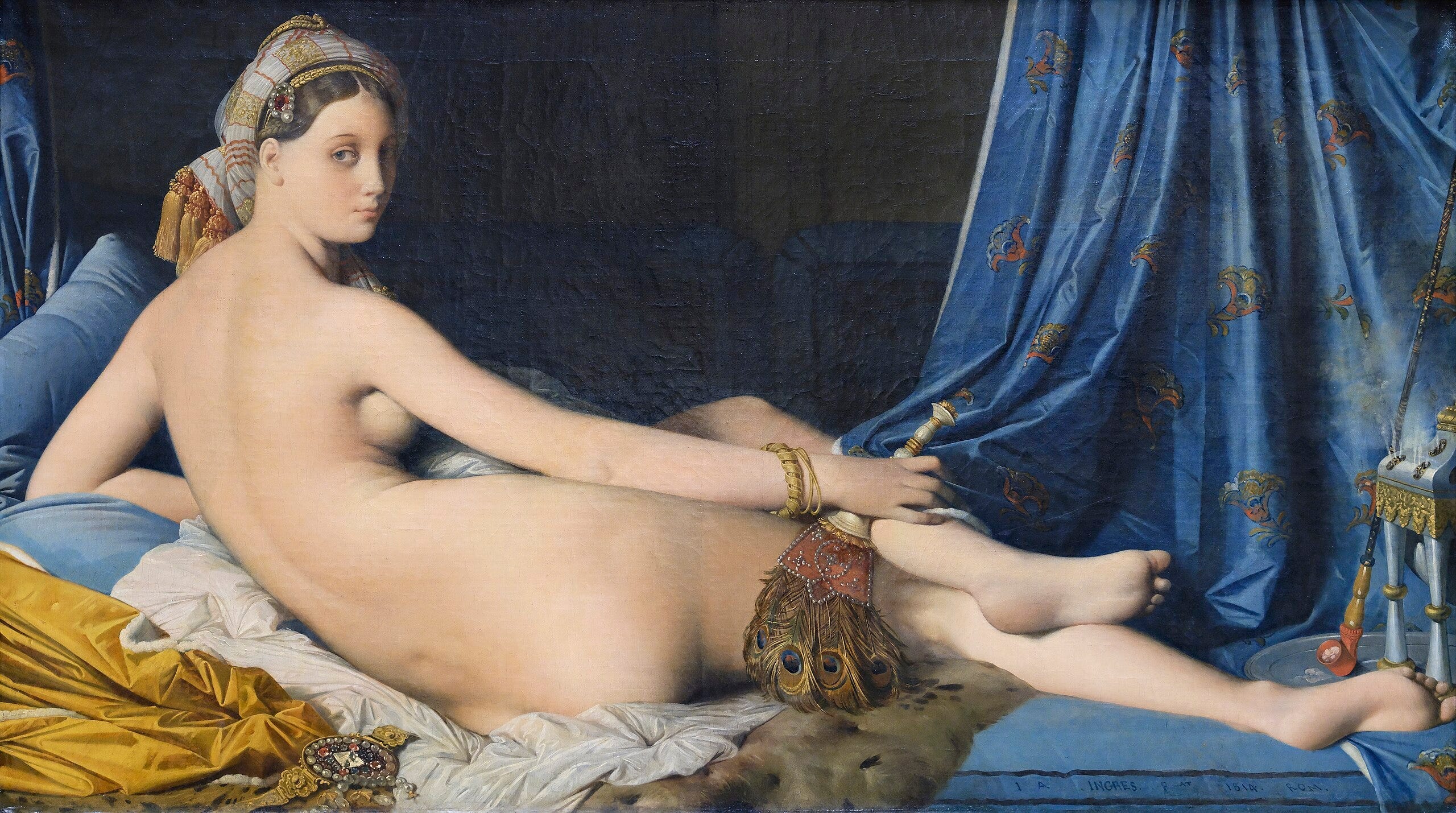
Ingres’s Grand Odalisque is a textbook example of this Orientalist excuse. He gave her extra vertebrae and an elongated, distorted back, nudging her away from ‘real’. She isn’t meant to read as a woman you might encounter. She’s an object, safely foreign, safely unreal.
By placing the body in a distant, supposedly primitive culture, the artist created a travel loophole. This wasn’t about sex. It was about learning. Or at least, that was the story. Anthropology smuggled in as erotica, and it became one of the most popular visual languages of the century.
This is the same mechanism I explored in The Dangerous Myth of Progress. It’s the Western gaze, or more accurately, the progressed gaze. Distance allows us to tell ourselves we’re looking at evolution rather than desire. But it’s the same trap Artemisia exposed earlier. If the subject doesn’t own the gaze, progress is just a refined way of turning people into objects.
Liberty and the naked truth
As we moved into the Enlightenment and the age of revolution, the loophole shifted from the Bible to the Dictionary. Artists started leaning on allegory. If you wanted to paint a woman with her breasts exposed, you didn’t call her Marie. You called her Liberty. Or Truth.
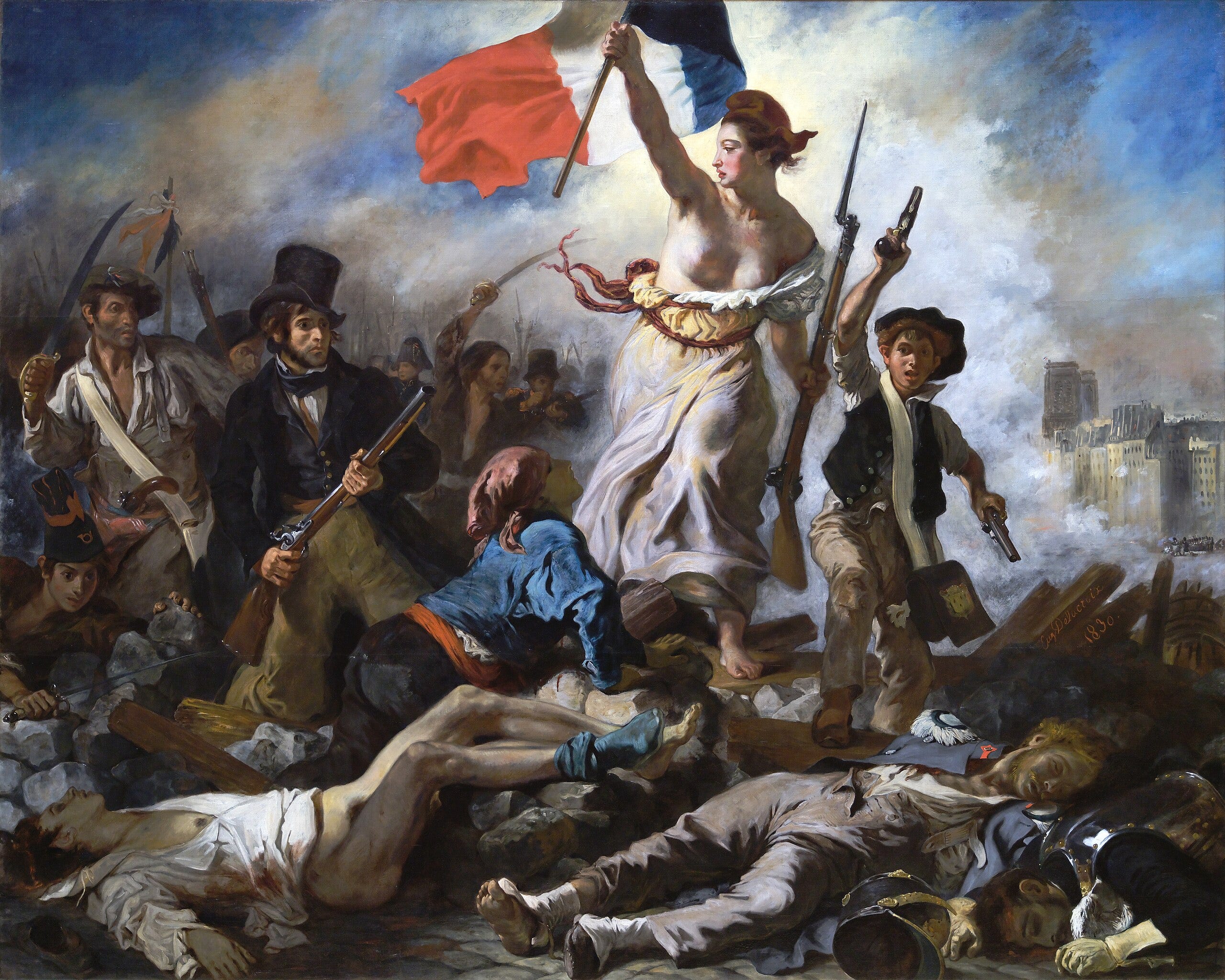
In Delacroix’s Liberty Leading the People, we see a woman charging over a barricade, the French flag in her hand. Her dress has fallen to her waist, but no one in 1830 Paris called it indecent. Why? Because she wasn’t a real person. She was an idea. Truth is naked because it has nothing to hide. Liberty is exposed because she is raw and fierce.
By turning the body into a symbol, artists could bypass the censors entirely. You weren’t looking at flesh. You were looking at a political statement. It was the ultimate intellectual fig leaf. As long as the body represented a noun like Justice or Reason, it was brand safe for the republic.
We still do this. Look at Dove’s Real Beauty campaign, or any form of empowerment marketing. We show skin to sell abstract concepts like self love or freedom. The nudity is allowed because it’s been rebranded as a social or political statement. Abstraction is the price of honesty. We find it easier to accept the bare truth when it’s personified as a concept rather than a human being.
The collapse of the fig leaf
Then came Manet. He lifted the pose of a classical Venus and painted a modern Parisian prostitute. He called her Olympia and refused every traditional loophole. She wasn’t a goddess, a saint, or an allegory. She was a woman in a bedroom, staring straight at the viewer.
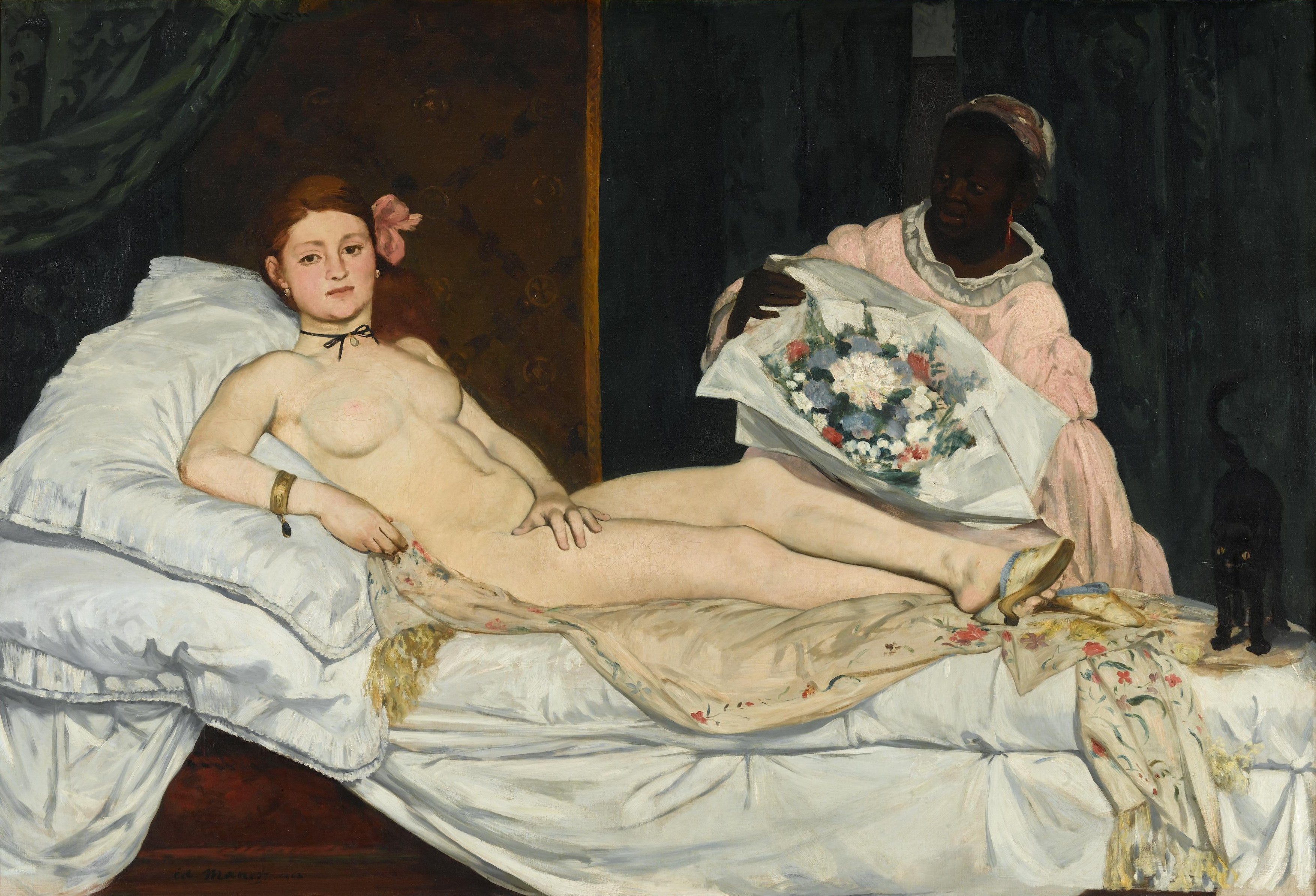
That stare was a small nuclear device. It blew a hole straight through the polite fiction of art history. Manet forced artists and audiences to be honest. Once the loophole collapsed, the next generation stopped pretending. Degas painted women in bathtubs. Renoir painted bodies in woods. Not Venuses, not symbols, just people existing in light and colour. The body became a site of observation and psychology, not moral instruction.
Manet proved that a naked woman could simply be a naked woman. But for centuries the viewer had been hard coded as male. It took another hundred years for that default to crack. In the seventies and eighties, artists like Sylvia Sleigh and Robert Mapplethorpe finally turned the lens around, treating the male body as an object of desire and glitching the ancient rule that men look and women are looked at.
While the art world today has largely lost interest in the male gaze, movies, advertising, beauty, fashion, and the broader entertainment world are still struggling with the transition. Letting go of objectification means losing the pull of the purely desirable character. And in the art of making money, that’s still a risk most industries aren’t willing to take. Sex sells, and everybody knows it.
The last human exception
Honestly, I thought this would be a fun research and write. It wasn’t what I expected it to be.
I started this project looking for playful loopholes we could maybe repurpose for today’s world. Instead, I found myself staring at much more than just naked bodies. I ran head first into unavoidable double standards, sexism of biblical proportions, and racism on a colonial, imperialist scale.
I had hoped to end on something breezy and uplifting. That optimism turned out to be buried deep inside the ugly.
Brand safety first, because it pays the bills.
You see, today, the curators of our digital salons are algorithms. Cold, straightforward and unambiguous. On TikTok, Meta, or any platform that pretends to be a cultural discovery engine, even a hint of nakedness is suspect. Even in a five hundred year old masterpiece. Why? Because the computer says no. “Boob beep boob, that’s boobs”. painted or not. Brand safety first, because it pays the bills.
These platforms are quickly becoming the only way for artists to find a tribe. So if you want visibility in the digital age, you have to behave. Avoid skin. Stay brand safe. That’s not just a constraint, it’s a tragedy. A redaction of our creative vocabulary and heritage.
The strangely hopeful part is that these historical loopholes show that humanity, with all its flaws and biases, still allowed just enough room for culture to keep moving. Have some healthy friction. The Pope would tolerate Michelangelo’s skin if he called it a Judgment. Nineteenth century prudes would forgive Ingres’s back if he framed it as Oriental.
In a strange way, our messy and biased ancestors were more helpful
than our clean, objective code.
In a strange way, our messy and biased ancestors were more helpful than our clean, objective code. The double standard cuts both ways. They left space to breathe. Now we have to find new loopholes. New ways of speaking human that machines can’t quite translate. And that will be worth paying attention to.
Art teaches us a few very practical things, how to embrace ambiguity, how to see context without manipulation, and how to resist the urge to sanitise discomfort away. That may be something worth keeping. Not just in galleries. Also in the palm of our hands.